
The Hidden Cost of Late-Night Rendering Before a Client Estimate
A Sunday-night estimate prep scene illustrates the real cost of slow visualization — and when self-serve or outsourced production buys the time back.
By Renderspace
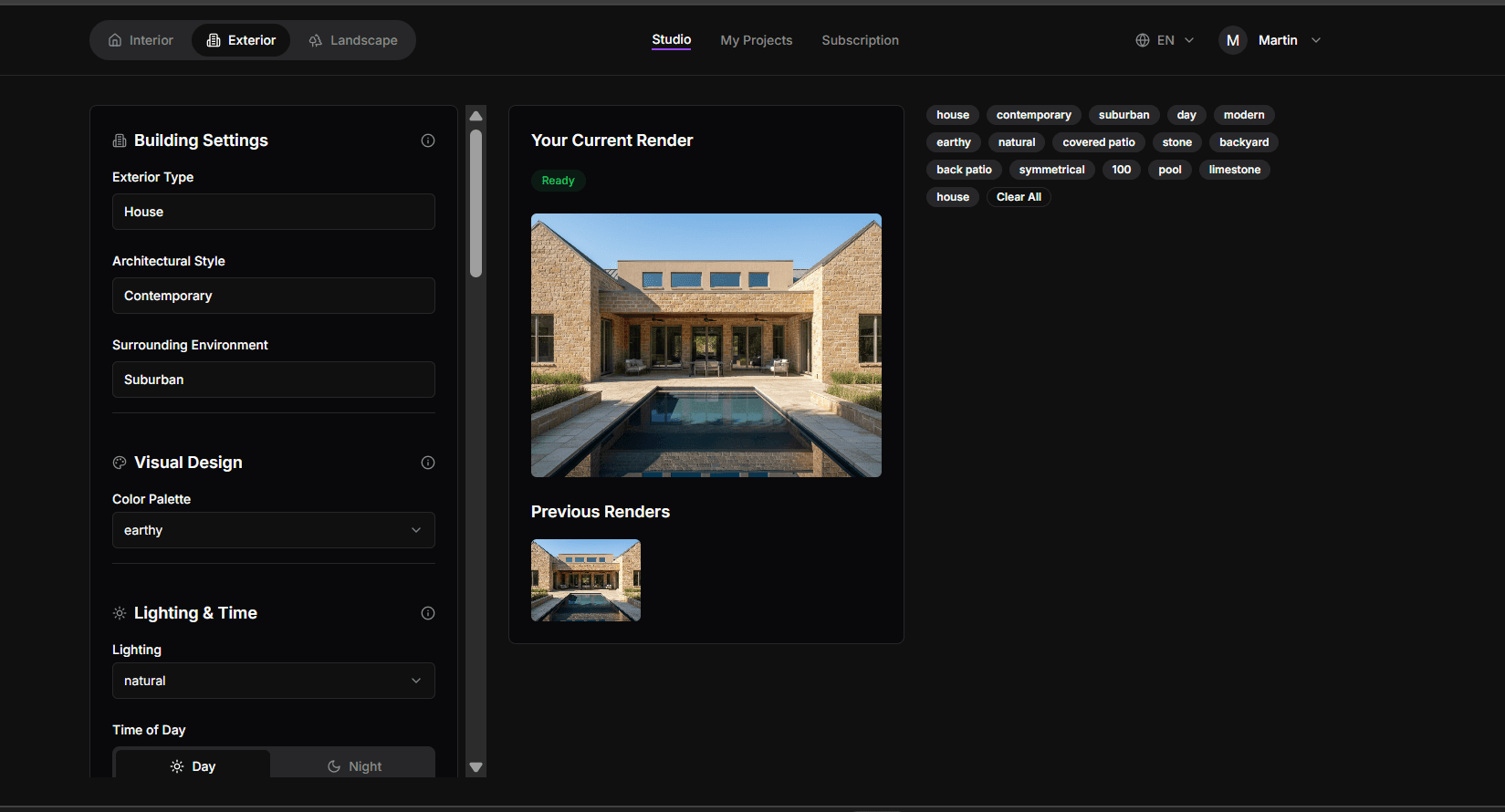
It is 11:40 on a Sunday night — hypothetically, but probably not far from a week you remember.
The estimate is at 9 AM. You told the client you would have something to show them. Around dinner you sat down to put together a concept. Around 9 PM that turned into fighting with a tool you do not fully know, trying to get one image that looks worth showing a paying customer.
Your spouse went to bed two hours ago. The pool still has leaves from Saturday. You told yourself you would deal with it tomorrow — except tomorrow is the meeting, and you are staring at a screen instead of asleep.
If this sounds familiar, you are not bad at your job. This is what happens when visualization work has no dedicated slot in the week, so it absorbs whatever hours are left.
The cost nobody puts on a spreadsheet
The Sunday-night render session does not show up on any invoice. It is not a line item. It is just something that has to get done before tomorrow, so it gets done — usually late, usually at the cost of sleep, family time, or the focus you wanted for the meeting itself.
Multiply that across every estimate you have ever prepped the night before, and you are looking at hours that never got counted and never got paid for. The cost is not the software subscription. It is that your scarcest hours — the ones after the crew goes home — are spent on work that should fit into a sales conversation, not consume an evening.
Why this keeps happening
Most visualization tools were built for designers with time to learn them — not for a contractor who needs one usable image before a deadline with no patience left for a learning curve.
When concept prep takes hours, it gets deferred until it cannot be deferred anymore. That is how Sunday nights happen.
When it takes minutes, the work moves to a Tuesday lunch break or a ten-minute gap between site visits. The render stops competing with your weekend because it no longer requires one.
That is the practical difference AI landscape design software for contractors is built for: photo-to-concept exploration in seconds or minutes, on a real job-site photo, while the conversation is still live.
What faster prep actually buys back
Say the render itself takes five minutes instead of four hours. That is not just time saved on the image. It is the difference between prepping Monday's estimate rested on Monday morning and prepping it exhausted after midnight.
Clients notice energy. A concept shown with confidence — because you had time to iterate on two material directions instead of one rushed pass — often lands differently than a single tired export you are hoping is good enough.
None of that requires promising miracles. It requires a workflow where visualization fits the sales rhythm instead of breaking it.
When even minutes are not enough
Some weeks, five minutes does not exist anywhere on the calendar. Six estimates are due and you cannot touch any of them, even the fast version.
That is when outsourced visualization for landscape contractors earns its place. Human Polish AI Render Packs put the Renderspace team on concept production: you send the brief, the team returns an organized package. Packs run 25, 50, or 100 concepts at $399, $699, and $1,199, with typical turnaround from 24–48 hours on the smallest pack to 3–5 business days on the largest. Your first 25-pack is $349.
You are not outsourcing because you cannot use the tool. You are outsourcing because the pipeline exceeded the hours you have — a common problem, not a personal failing.
Two paths worth trying before the next late night
Self-serve on one real job. The First Job Test is $19.99 for 40 credits over 7 days — enough to run the workflow on an actual estimate and see whether concept prep still belongs at 11 PM.
Hand off a packed week. When volume is the bottleneck, not skill, an AI Render Pack scopes production before you pay and delivers concepts without you touching the tool at all.
Nobody got into contracting to spend Sunday nights fighting software. The tools worth keeping are the ones that get out of the way fast enough that they stop showing up as a cost against the rest of your life.
Related reading
- AI Landscape Design Software for Contractors: What It Does Well—and What It Doesn't
AI landscape tools are fast at concepts from real photos. They are not site plans, engineered drawings, or permit packages. Here is how to evaluate the category without wasting an afternoon.
- Outsourced Visualization for Landscape Contractors: When It Makes Sense
A practical framework for deciding when to hire, freelance, self-serve, or use Human Polish as your outsourced visualization department.